Showing posts with label Marketing. Show all posts

Wednesday, April 29, 2015

Market Watch: Why The Bottom is Falling Out From The Used Bike Market

Wanting to sell your nice lugged, steel road bike? You may want to wait a couple of years.


There is no market indicator for the used bike market. Like all unofficial, unregulated cash in hand markets there is no "official" way for tracking improvement or decline of sales, especially when the sellers are people unloading their second-hand goods on others. However, as somebody who actually pays attention to these things, I have picked up on a market trend which will probably benefit consumers more than anyone else in determining what their next bike purchase will be. 

If you, like me are a die hard vintage bike collector, now is not the time to keep adding old bikes to your collection. If anything, now is the time to start letting go of whatever old bikes you're able to, probably at a loss. However, if you have an Eddy Merckx Super Corsa or a Colnago Art Decor, you may definitely want to keep holding on to it. Look at the new bikes that are coming out. Look at the technology bundles offered. Look at the prices. Especially the prices. The prices of new bikes are blowing my mind. Never before have I seen so many quality bicycles at such affordable prices being offered new. Some retailers are offering steel cyclocross bikes with disc brakes for about $600, for example. These bikes also come equipped with brifters, ISIS drive or Hollowtech II bottom brackets and compact gearing.This is in stark contrast to the 2008-2009 calendar year, when even the most basic, Shimano Sora equipped bicycle with a carbon fiber fork was selling for about $800.00.  What's happening that is driving down the prices so much, especially in light of all the new technology coming out on bikes nowadays? Let's discuss some of the reasons.

Bicycle Technology Arms Race:

2015 is seeing a lot of concept technologies such as electronic shifting and 1x10 drivetrains becoming mainstream on many production bicycles. Only a couple of years ago, Shimano Di2 was only offered on the most expensive $10,000.00 bicycles. Nowadays Di2 technology can be found on bikes costing less than $3k retail. Mountain bike manufacturers have introduced an extra wheel size into the market, now offering three options of wheel sizes for their models. Sram 1x10 now is in direct competition with Shimano SLX. There are about a dozen new innovations that have come out in groupset technology over the last couple of years alone. All of the groupset and bicycle manufacturers are vouching for your purchase, and this is one of the reasons prices are lower this year. Retailers and manufacturers alike realize that they need to lure in early adopters to all the new tech that has come out. Anyone who is trying to sell a  square tapered bottom bracket, Shimano Sora component equipped bicycle for $800 in 2015 will be quickly squeezed out of the market like an overgrown pimple. Bicycle companies are also realizing that they have all been fishing out of the same small pond for a while now, so many companies are lowering their prices to attract a broader consumer base. All this is resulting in awesome bikes becoming available for everyone. For the same price or less than the retail price of an iPhone, someone can now buy a legitimate bike of good quality. 

Online Retailers:

Online retailers have forced the hand of major bicycle companies to evolve or die to the new consumer mindset. The harsh truth is that a $9.00 an hour bike shop employee doesn't know more about bike fit then what is already extensively available on the subject online. As someone who never had a bike fit, it didn't take me a physics degree to figure it out. Welcome to the internet baby, it's 2015! If I were to go back in time to 2007 when I bought my first road bike, I would have just gone to the bike shop, found a bike that I was comfortable on and look for the same size bike for hundreds less from an online retailer. At the expense of their corporate bonuses and their bottom line, bicycle manufacturers are finally starting to play ball with smart and informed consumers, which are quickly becoming that vast majority thanks to the internet. Without ever having mounted a bicycle, somebody can figure out that the super nice, quality bicycles are made in Taiwan, and the average but still very good bikes are made in China. It's becoming common knowledge that all bicycles are being manufactured in the same factories, regardless of brand name. Only a select few niche bikes are handcrafted or made exclusively in certain areas. But the fact is that a guy riding a Canyon and a guy riding a Merida could very well be riding essentially the same bike with different wrappers put on. 

The Used Bicycle Market:

The grassroots, organic used bike market, full of retro-grouches, hipsters and flea market professionals, has finally made a dent on the profits of major bike industries. So much so that at there are loads of good new bikes now available at the $500 range, just a couple of hundred dollars more than the arbitrary $300 Craigslist spending limit. The bicycle industry is getting tired of all of the bottom feeders making residual income of their inability to see what the consumer wants. They are finally waking up and lowering their prices for this very reason. That is why, at least for the foreseeable future, the bottom is out on the used bike market. People may be selling their bikes at a loss or not selling them at all. I see a trend of most bikes on craigslist selling for about $120, and most high end bikes for about $500. At the $500 they will probably be Dura Ace or Campagnolo equipped Colnagos. That is how much of the bottom will be eaten out of the flipper's market this year. There will be little demand from collectors so those who own nice vintage bikes may just want to hang onto them.

Some Things are Cheaper to Buy New than to Replace:  

Many people may not want to hear this, but it's true. Once a critical part on an old,  classic bicycle breaks it may take a few months of combing through eBay to get an exact replacement. A lot of the tools for working on older bicycles are also becoming obsolete. It may finally be time to retire that cottered crank bicycle project with the swiss bottom bracket and the Campagnolo Cambio Corsa shifting you've been working on and just hang it on the wall for the sake of art.

Market Forcast for 2015:

Dorel Industries will probably close out the year on a high. Shimano shares will increase because of the Deore SLX component line and the trickle down in electronic shifting technology to their 105 and Ultegra component range. Sram will have big profits this year but they are not a publicly traded company. Expect a bull-run year from Garmin as they have made their bike computers compatible with the online app Strava. Expect shares to rise to peak levels in the summer months and slowly start going down in the fall. There you go, I just made you some money, now go on and buy one of those nice, brand new bicycles! (Or you can send me a check for the free advice, I'm not actually a stockbroker so I'm not in the money like you are).



Tuesday, February 10, 2015

Cycling's Cost of Entry

Getting into Cycling:
Cheap, Expensive or Both?


When looking at the kinds of bikes professionals use (and I mean the guys we actually see on TV, not riding around the neighborhood on Sunday mornings), many formulate preconceived notions that cycling is a rich man's sport, similar to playing golf and yacht racing. The truth is that there is a slight bit of truth, however small it may be, to that stereotype. It's a view that often gets compounded and reinforced by the bicycle industry itself. Most bikes seen in the Tour De France are actually rebranded custom made bicycles that are not available in stores. The ones that are, however, can sell well over $10,000 USD. Does that mean that cycling is unattainable for someone that isn't a CEO of a fortune 500 company or a trust fund beneficiary?


Let's discuss this topic not as the cost of entry into competitive cycling, which can be an endless and upside down venture. Rather, let's talk about whether the average kid on the block or adult can get into a decent bicycle at a reasonable cost.  


Consider the image that competitive cycling has left on the average person. Competitive cycling, at least here in the U.S, has no development leagues and no academic support to promote the sport. For example, there are no cycling teams in high school and no community groups that teach people about bicycle racing. Although USA cycling may call itself a development program, it's not a program where just anybody can participate. There are membership dues, racing fees and equipment costs that are not covered by this organization. In addition, to state things plainly, USA Cycling is behind on the times in regards to issues like racial and economic diversity among it's members and granting female athletes equal opportunities for competition*.  Let's also point out that the most notable athlete to come out of USA Cycling, Lance Armstrong, was the biggest cheat and liar of them all. Meanwhile other riders with real talent, like Colombian cyclists, have been largely ignored for about 20 years until the recent crackdown on doping has forced the cycling community to recognize where the real talent is. 


Does that mean that cycling is not for the masses? Does that mean we should all just buy our bikes from Wal-Mart and quit trying to compete? As things stand, many of us will be excluded from competitive cycling simply by default. But that doesn't mean that our passion for cycling should end there. Should someone tell their kid who is into basketball they shouldn't play because they are too short to compete? The same line of reasoning can be applied for someone who is into cycling. Maybe our pockets aren't deep enough to afford the equipment and training that would get us to compete on a professional level. So is there a happy medium in regards to all of this?


We can find solace in knowing firsthand that getting into a decent bicycle is attainable for the majority of people on a real middle class income. If a single person makes above $25,000 a year, for example, there is no reason why they can't afford a bicycle between $300 and $800. Let's discuss a price comparison between common modern day gadgets that most people buy and the cost of getting into cycling for each respective item. 


Consider the smartphone. It is not a necessity to own a smartphone, however the majority of people living in the U.S now own one. Let's consider some of the prices for these types of phones.

The Samsung Galaxy S5: $599.00
iPhone 6: $649.00 to $749.00
LG G3: $699.00

Now let's see what types of bicycles someone can buy new for about the same prices

Fuji Ace 24 youth road bike: $439.00
Mercier Kilo Track bike: $399.00 to $449.00
Motobecane Fantom CX: $469.95
Motobecane Mirage Pro: $549.00
Motobecane Boris X5 Fat bike: $599.00
Motobecane Gran Tourismo:$699.00
Motobecane Super Strada: $799.00

Some might say that they don't pay full retail price on their smartphones. How about on game consoles? Let's compare the cost between game consoles and the cost of respectably priced bicycles.

Playstation 4:$399.00
Xbox One: $349.00
Wii U: $300.00 to $360.00

Let's see what kinds of bicycles we could buy for the price of a game console

Mongoose Dolomite Fat bike: $212.00 to $250.00
Windsor Track bike: $279.00 to $299.00
Gravity Deadeye Fat bike: $299.00 to $399.00


Sometimes we might think that a good bicycle is just not affordable, however, on reviewing some of these prices we might just be prioritizing our gadgets like phones, games and tablets over our fitness. I included the Mongoose Dolomite in my comparison because although it is sold at Wal-Mart, it has been proven to be a real bang for the buck bicycle in terms of being a ridable bike and in terms of quality. In addition to the bikes listed, there are thousands of lightly used bikes sold locally and through online classifieds that are of good quality and in some cases professional quality. One just needs to know where to look. 


I know that what I am saying might not be enough to satisfy someone who is really talented at cycling but cannot afford the best equipment. I think those who would still like to compete but can't afford to do so in the main arena should organize themselves in their communities and hold non-sanctioned races with other low to moderately priced bicycles. There is no law forbidding people getting together for competition, and this includes cycling. There is more power in numbers, and when people get together, others will take notice and follow suit. When a large number of the overall cycling population starts competing outside the establishment, then organizations like the UCI and USA Cycling will have to take notice and start making concessions for those who they left out of their inner circles.


In conclusion, in overall terms of getting a durable bicycle, the cost of entry into cycling is attainable to most of us. It is mostly up to us to see the half glass full and take advantage of this to become good cyclists.

*Other source material for this topic can be found in the following media links.

The Guardian
The Daily Camera


Thursday, November 13, 2014

Fat Bikes...It's what's hot right now.

Fat bikes point to the future of mountain biking

Courtesy of fat-bike.com

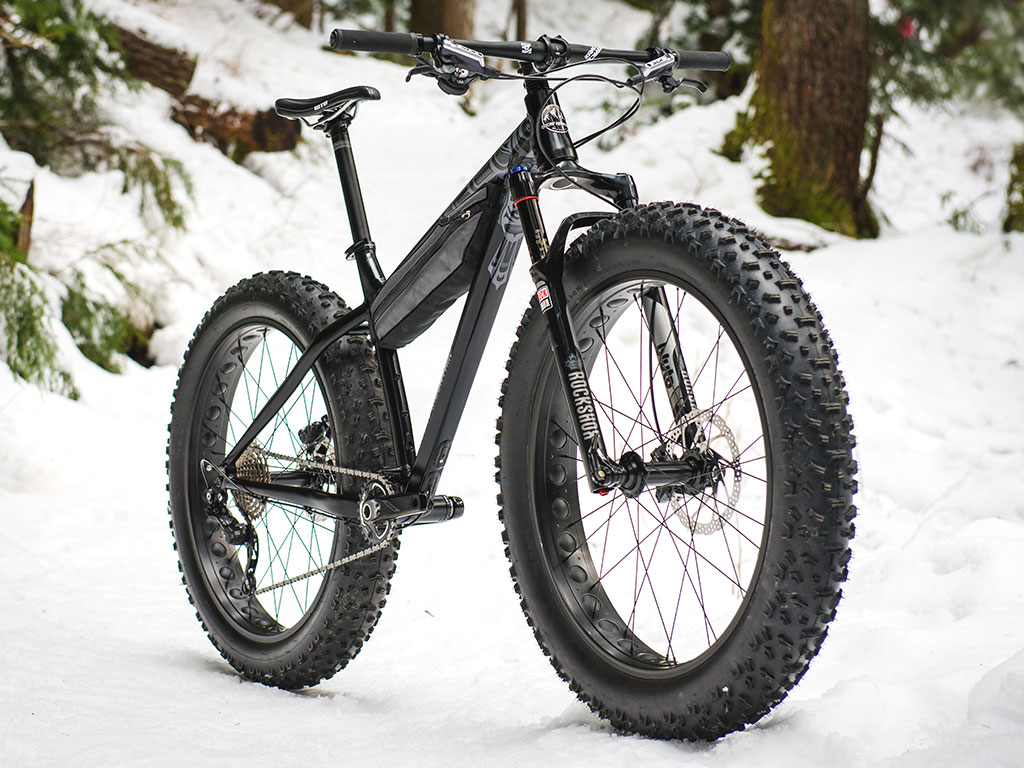
After years of racing bikes being the predominant style of bicycle that has been constantly promoted to consumers, regardless of whether or not people had intentions to race, a new type of bike is making big waves in the mountain bike scene. Enter the fat bike, a bicycle that can go anywhere, do anything. We embrace it's arrival with open arms as we attempt to wrap around it's massive girth.

What makes fat bikes so special? The 4 to 5 inch tires leave a wider footprint that allows the bicycle to float over soft terrain such as snow and sand where regular tires would simply sink and become bogged down. This makes fat bikes capable of being taken off the trail to places once inaccessible to bicycles. Ever thought about riding a bicycle down the Oregon coastline? This bike can do that, and much more. The bicycle pictured above has a Rockshox Bluto fork, however a front shock is overkill for what most people will be using the bike for. The plush, wide tires offer plenty of shock absorption without the addition of a front fork. With the addition of a front fork, this bike can probably ride straight off a cliff without any problems whatsoever. 

Department stores have caught on early to the trend while most bike shops have not. You can now buy a department store, steel fat bike such as the Mongoose Beast or Mongoose Dolomite for around $200. Bike shop quality fat bikes start around $500 and up and are mostly found through online retailers. 

Since the invention of the mountain bike, people have wanted a bicycle that could test the limits of what is possible. However, the industry focused more on how to ride over terrain faster than seeking to test the limits of where a bicycle could be ridden. This bicycle may finally be the answer to that long awaited expectation. This is the biggest trend, as well as the only trend, happening in the world of bicycles at this time. Brick and mortar retailers need to zero in on this opportunity and stock as many of these bikes on their shelves as they can possibly fit in their stores. Forget 27.5 bikes, forget fixies. There is a downward trend of new bicycles being sold because there is simply no new interest to buy the same kinds of bikes that have always been around, maybe with a few tweaks but nonetheless the same candy with a different wrapper. This bike is a different thing altogether. I'm going to save up to buy one of these soon, and the sticker shock isn't going to deter me this time. I have personally not been as excited about a new type of bicycle hitting the market as I have been about the fat bike.  This bike, when purchased will complete my stable and may end up replacing my full suspension mountain bike. So stay tuned for a future review and keep subscribing to my blog for more posts.


Saturday, September 27, 2014

Vintage Bikes of the future, 26 inch wheel mountain bikes?

Why you should start collecting 80's and 90's mountain bikes


They say 30 years makes a classic. So pretty much, judging by my time here on this earth, I'm pretty much a classic myself. Classics enjoy the respect of enthusiasts and turn heads when being showed off in a modern environment. The mountain bike as it originally was has also become a classic. 

Crested Butte, 1980. There was a repack mountain bike race that day-viewed the first generation of mountain bikes, a far cry from what we would consider to be a mountain bike today. Cantilever or drum brakes, bull moose bmx-style handlebars, and heavy frames with long rear triangles were on the forefront of technology back then. Many of these bikes have sadly not made it into collector's hands after decades of rigorous thrashings on the mountain bike trail. The ones that have made it will soon be as valuable as the most expensive vintage Italian road bikes.


With the recent popularity of vintage road bikes and fixies, old ten speeds have enjoyed a vast number of avenues for replacement parts and upgrades. Most tire manufacturers still make 27" tires, for example. 27" and 700c wheel replacements are still to be found for many of these bikes, even replacements for rear wheels that require a freewheel instead of a cassette. In fact, ever since 700c became the popular wheel size on road bikes, they have been able to co-exist with 27" bikes until this day. I'm guessing back then bicycle companies respected the consumer's wallet, that or 27" wheel touring bikes were seen as benign and not a threat to 700c wheel racing bikes. 

Never in all of bicycle history has there been an attempt so blatant to eradicate a wheel size option than what the bicycle industry is doing with regards to the 26 inch mountain bike. A year ago, I wrote an article saying this would happen, based on market trends and feedback from working at a bike shop. It seems that overnight, all of the good, mid-school wheels and components have either been bought up or priced up at a 300% inflation rate. This is an unexpected outcome to the 650b and 29er wheel craze of the last few years. I can't seem to find anyone who sells good 26" freewheel threaded wheels anymore, unless they are heavy bolt ons for cruisers. The only wheelsets I find available are cassette compatible and top end brands like Mavic. What ever happened to the Zac 19's?

I can only compare what is happening to the 26", unsuspended, steel mountain bike to what happened to film photography. All the powers that be in the photography industry got together , and in less than a decade, film photography was gone. I saw my first digital camera around 2001, a box-like object that used a floppy disc and could only take five pictures at a time. By 2004, 3 mega pixel cameras where starting to become common among most people. In 2009 when I took my film camera to Germany, I received a few impressed looks and one person even told me that they had forgotten what a film rewind sounded like. I had to take my film to a specialty camera store to get it developed, and that was 5 years ago. I still have my film cameras (good ones, at that) but seldom use them because I don't know where I'll develop the little film that I have left in my refrigerator. Were film cameras that much more inferior than digital cameras? No, in fact a 35mm camera with a really sharp lens could get the equivalent of 64 mega pixels in image resolution. My medium format camera could get an even much higher resolution still. So why did the industry have to force film into obsolescence?

For the same reason why the bike industry is forcing out the 26" wheeled mountain bike: to make money. By forcing everyone to upgrade across the board, the bicycle industry is forcing consumers to buy their product, because all other options have been eliminated. As much as I loved my film camera, once all of the one hour photo labs started closing down, I really could not use it anymore. So let's say I were to break a wheel or a 7 speed shifter on my mountain bike. There may soon come a time where that will mean the end of that bike's lifespan as a mountain bike. It will from that point forward have to become a beach cruiser, because those will be the only wheel and tire options that will come in 26 inches. As a desperate measure, I may just have to buy a Wally World bike or a Magna bike from Target with 26 inch wheels, just to swap parts onto my old mountain bike. 

As consumers, we can choose with our wallets whether or not we like what the bicycle industry is doing. When I say bicycle industry, I am not including bicycles found at department stores, many of which still come in 26 inches. I'm including The two big American owned companies in the industry and the one big but still emerging Taiwanese "giant" who are driving the change. "The Big Three" currently own most of the patents in the industry and are known to buy out other companies just for the sake of eliminating the competition. If we don't like what they're doing, then we don't need to buy their mountain bikes, it's that simple. When we start seeing more aftermarket parts available for our old-school rigs, then we can entertain the idea of buying their products again. 

In conclusion, forced obsolescence is never a good thing. Look what that did to letter writing, no one writes hand written letters anymore. Fewer people read the printed page, now you see people reading on their tablets and "eBooks". People don't invite other people over to look at their photo albums anymore, everything is shared online and invitations are kept to a minimum. When something becomes obsolete, our values and manners suffer. Some people will say that it's just a wheel size, that it's just a hobby and that truth be told all bikes were meant to be disposable anyway. But it's much more personal than that. Pricing out the consumer or forcing an expensive change on them is taking advantage of their long time integrity and the fact that they're cyclists. It's telling them that there's a cost of entry and a economical barrier to doing what they love to do. It's telling the consumer either pay up or quit riding a bike. It's an underhanded and indirect way of pre-qualifying people to do something that everyone should have the right to do; ride a bike. Straight up class warfare, if you ask me. 

Here's my answer to what the bicycle industry is doing. I'm going to start collecting vintage mountain bikes and components. I hope to accumulate enough parts to do my own maintenance without ever having to step foot in a boutique, hipster-owned bike shop. Once I can no longer do maintenance on my bikes, all future mountain bikes will come from Target. That's how I'm going to choose with my wallet and I'm sure others will follow suit. The modern bike boom is over, it's been over for about 3 years now. With this forced change the specialty bicycle market will not keep enjoying it's temporary run of sales for very long. Once the bicycle demands of the upper echelon of society are met, they will not derive any more profit from the rest of us. Until another Lance Armstrong comes along and gets people into Tour De France fever, most people will no longer see the need to buy an expensive bicycle again. 

End of rant.


Wednesday, April 25, 2012

Coming Soon: A bicycle's point of view

The Photographer's and Cyclist's corner to become
A Bicycle's point of view

To my loyal fans (counting all four registered at the moment) I would like to extend my appreciation for your support, views and patronage to my current blog via clicking the Google ads which I get paid for. Currently, my blog has experienced a decline in viewership, so much so that I have decided to rethink my strategy about what I write and how I advertise it.

I have been focusing on general purpose topics regarding cycling and photography. These are two subjects dear to my heart  that interrelate to each other, given the sense of tranquility both offer to me personally.  Although I really enjoy photography as a hobby and have even made clients and small profits along the way with it, I take more out of writing subjects that relate to the cycling world and it's immediate and long term impact on society. Therefore, I have renamed my current blog "A bicycle's point of view" literally meaning the posts from here on out will come from the point of view of my bicycle. I will load my camera and give the reader the best interpretation of my vantage point from my bicycle rides. Being that it's not always easy to take the time and resources to do this, so my posting might be on a less regular basis. Yet all posts will be original with my own photos added.

I don't think there is enough on the internet about cycle-touring or randonneuring, or mountain trekking on your bike. There is also not enough posting about long distance travel, world travel, riding in the countryside, people using (not collecting) vintage bikes, bike riding in Texas, free training advice and so on and so forth.  I plan to change that and maybe gain some followers along the way. The new blog will also cover my transition from a daily driver to a daily pedaler, as transit centers start to open in my area and the car takes a secondary role in my commuting. 

I am also looking for sponsorship to support and promote cycling on my blog. If you are a bike shop, manufacturer, apparel company or know of someone who is, please send them over my way. I can even feature sponsor's products on my blog, just send me something and I will let everyone know about it. I will add a link to my website promoting any business who would like to sponsor me with their ads. 

The link to my new blog page is www.bicyclepointofview.blogspot.com

Stay tuned and thanks again for subscribing!

Johnny


Wednesday, December 14, 2011

Jonathan and Taryn: Crusing into the Sunset

Jonathan proposed, Taryn said "yes!" Congratulations guys!

Who said a photographer's work is done in the winter? I was fortunate to get this last minute booking for this young couple. Due to the reduced amount of daylight in December, I had to be creative on some of the shots that I took. Here are some of the results.


The gondolier is elegantly dressed as he rows this couple through the calm waters of Lake Carolyn

Gondolier, decked out with top hat and tail coat.
You will notice that I also ventured towards the surrounding area around the canals for this photo-shoot. Las Colinas is full of great architectural buildings and sculptures and provides interesting photo opportunities.


Thursday, December 1, 2011

A day with Johnny and Dorcas

Photography tips with Johnny and Dorcas


It's all about the details! Brides love the details that go into making their special day.
I found this shoe shot to be one of my more sucessful examples yet.
One of my colleagues recently invited me to do an assist for our mutual friend's wedding. It was a pleasure to take the time to photograph this young couple. Here are a few highlights of the day's activities.


Shooting in a dark reception room will require some creativity and some additional lighting other than your carry on flash. Be prepared to "take out the big guns" with your studio lighting and remote flashes. 2011 Jonathan Guzman

Brides love the details on their wedding dress. Be sure to at least have one picture like this in the album.
Every once in a while it's good to shoot a wedding for fun and let someone else do the worrying. Part of networking as a photographer is learning how to get along with the other kids on the block (fellow photographers) and sometimes doing a good deed is it's own reward. Either way each wedding will add 2 to 3 shots to your growing portfolio. These are the one's I think I will keep.

Friday, August 5, 2011

Venetian Style Photo-shoots

A Little Piece of Italy In My Own Backyard

As a photographer I try not only to specialize in one thing only. Weddings are a seasonal item and the bulk of good weddings will occur between March and June. This is because, depending on what part of the world you are from, these are the most temperate months of the year. September is another popular Month, and in Texas specifically, there can be warm weather all the way into November. By November, highs can still be in the mid 80s in Fahrenheit. 

So this brings me to my next point, What does one do the rest of the year? Does one simply stop taking pictures? A hobbyist probably will but a professional does not. That is because even when there are no weddings to shoot for the year, a professional is always trying to leave the door open for next year. This involves the process of getting referrals and marketing your business to other potential wedding clients in the future. This can be done, not only at the wedding itself, but in places you know people will be preposing. One such place are the canals in Las Colinas, that happens to be in reasonable distance from me.

I like to say I have a piece of Italy in my own backyard. On an evening stroll through the river walk you can the these gondoliers singing Sinatra or Yanni songs to their star-struck guests on board, which are usually engaged in romantic kissing to even know if he is singing out of key or not. 

Seeing that there were no other photographers around already doing it, I booked a cruise for my wife and I for our 2nd year anniversary. Upon making the reservation I was able to talk to the co-owner of the business (these small businesses are usually family run operations, even the reservationist might be the owner at times). I let them know I was a photographer and would be interested in working with their clients so that they had pictures of their wedding proposals, anniversaries, or other events that they would need a photographer for. This company loved my material and brought me in as their event photographer, and I have been able to build a great relationship with them as well as their clients.

So whether it is an arboretum, botanical garden, river walk, city park, or any other place of considerable beauty that people like to go to prepose, this is an opportunity that is knocking on a photographer's door. If you are a photographer looking for business then stop worrying about search engine ranking and website appearance. Instead go to the people directly and solicit with them. I know other photographer colleagues and competitors with great websites, but no business. This method of marketing works, and it will be a source of extra income in those slow months of wedding photography.

For more information on the work I have done with this company, visit their website